The Foyer Files: Reading a UK Noticeboard Before You Trust It
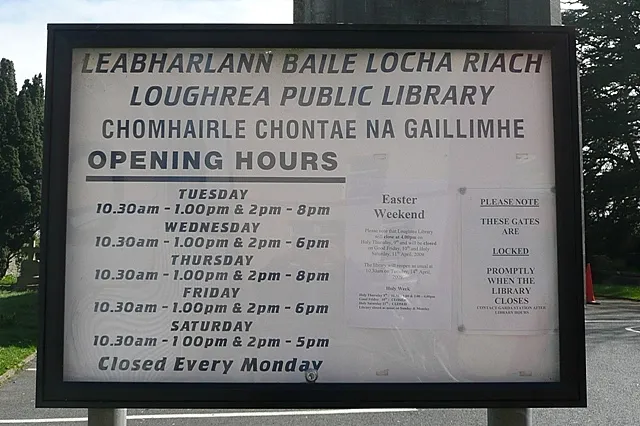
Photo: Graham Horn, CC BY-SA 2.0, via Wikimedia Commons
There is a particular kind of hope pinned to a library noticeboard. It is a rectangle of cork near the self-service machines, holding a yoga class, a missing cat, a charity quiz and a card reading 'Reliable gardener — local lad'. The paper is curling. The mobile number has been rewritten in biro. And yet, if you want to find out what is actually happening on your street, that board is still one of the most honest directories in the UK.
Online listings are useful. FindIt UK exists because they are. But a physical noticeboard has a filter that algorithms do not: someone had to leave the house, ask permission, and push a pin through paper. That does not make every notice true. It does make it worth reading properly.
Start with the frame, not the flyer
Before you read a single advert, look at the board itself. Is it in a library foyer, a post office window, a village hall porch, a church noticeboard or the front of a corner shop? Each has its own rhythm. Library boards tend to carry classes, support groups and council notices. Post office windows lean towards services: cleaning, odd jobs, tutoring, pet care. Village halls are where the annual show, the choir and the parish council collide. Church porches are quieter but often hold the most settled community groups. Shopfronts are the wildcard — sometimes a single card for a dog walker, sometimes a whole grid of them.
The frame tells you who checks the board. A library with a date-stamped 'notices removed after six weeks' policy is doing you a favour. A shop window with three layers of tape and a poster for a summer fete in November is telling you something too.
Freshness is a physical thing
You can often date a notice without reading the date. Look for tinsel in October, a dried-out holly sprig in February, or a QR code printed so small it predates the habit of scanning everything. A crisp A4 print with a 2026 date and a working email address is a better bet than a faded card that says 'new group starting soon' and nothing else.
Check the contact details against the season. A gardening service advertising 'autumn clear-ups' in spring may be a stale card, or it may be a firm that never took the old one down. Either way, it is a prompt to ask. Event notices should have a specific date, a venue and a way to confirm. If the only date is 'every Tuesday' and the board is in a building that has been closed for repairs, you have your answer.
The duplicate tell
A useful trick is to scan for repetition. The same mobile number can appear on three different cards with three different names — 'Dave's Gardens', 'Green Fingers Local' and 'Affordable Tree Work'. That is not necessarily a scam. It might be one person covering several services, or a lead-generation operation printing generic cards. But it is worth a question: which business am I actually calling?
Duplicated adverts also show up as identical wording in different handwriting, or the same stock photo of a smiling cleaner on five separate cards. Real local groups tend to have specific details: a named hall, a vicar's phone number, a chair's email, a date that matches the school term. Vague notices are not automatically bad. They are simply unfinished.
Cross-check before you call
Take the notice as a lead, not a conclusion. Search the group or business name alongside your town. Look for a landline, a street address and a recent post. If it is a community group, check whether the hall or library has a booking list, or ask at the desk — librarians are an underrated local search engine. If it is a tradesperson, ask for an address and check it on a map. A PO box or a virtual office is not a crime, but it does change what 'local' means.
Use online directories as a second opinion, not a replacement. FindIt UK listings, council-run trader schemes and community Facebook groups all have different blind spots. The point is to see whether the story holds together: the noticeboard card, the online listing and the person on the phone should describe the same outfit.
A pocket checklist for 2026
- Date check: is there a specific date, season or start date? If not, ask.
- Venue check: does the notice name a real hall, library or street?
- Contact check: landline, mobile, email — and does the name match across them?
- Duplicate check: same number or wording on other cards?
- Permission check: does the board look managed, or is it a free-for-all?
- Cross-check: one search, one phone call, one question at the desk.
- Trust your gut: if the notice is curling and the answerphone is full, keep walking.
The noticeboard is not a relic. It is a slow, physical search engine with terrible ranking and excellent local knowledge. Use it as one source among several, and you will find the yoga class, the gardener and the quiz night that the internet never bothered to index.